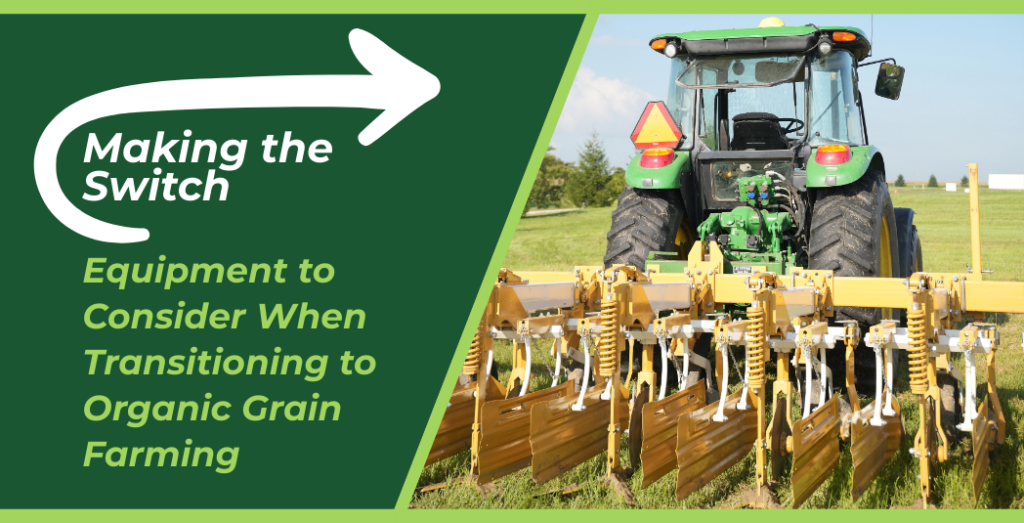
Transitioning from conventional to organic grain farming doesn’t mean starting from scratch. You can keep most of your existing equipment and build out or adapt over time. The key differences? Organic systems rely more on mechanical weed control, soil building tools, and postharvest handling that meets organic standards. Here’s what to consider.
Table of Contents
- You Likely Already Own Most of What You Need
- Top Equipment to Consider for Organic Systems
- Recordkeeping Doesn’t Need Fancy Tech
- Borrow, Rent, or Share When Starting Out
- Bonus: Tools That Support Soil Health
- Conclusion
1. You Likely Already Own Most of What You Need
Many conventional tools like planters, combines, grain carts, and tractors still work in organic systems. The real difference is in management, not machines. Organic certification doesn’t require brand new equipment, just practices that support soil health and eliminate synthetic inputs.
2. Top Equipment to Consider for Organic Systems
Weed Control Equipment
Since herbicides are off the table, mechanical and cultural weed control become essential.
- Rotary Hoe
Great for early season weed control, especially just after planting. Pro-tip: Make sure your spoons are well-sharpened or replace if worn. - Tine Weeder
Effective for shallow, broad spectrum cultivation across multiple rows. Can be used pre and post emergence. - Cultivator (Row Crop Cultivator)
Essential for mid season weed control in row crops like corn and soybeans. - Danish Tine Cultivator
A lighter cultivation tool, ideal for early season passes. Provides good soil stirring without disrupting young crops. - High Residue Cultivator
Designed to handle more biomass, including crimped cover crops. Adjustable sweeps of different lengths make it useful later in the season or in high-residue systems. - Harrow
Useful for pre-emergence weed control, especially to disturb tiny white-thread stage weeds before the crop emerges. - Flame Weeder (optional)
Useful in smaller fields or for specific crops, especially during pre-emergence. - GPS Guidance (optional but highly useful)
Increases accuracy during cultivation passes. Especially helpful when returning to narrow rows for second or third cultivations. Reduces crop damage and operator fatigue while improving weed control precision.
Check out The Land Connection’s Mechanical Weed Control Field Guide, written by experts Sam Oschwald Tilton and Hans Bishop.
Organic systems often require multiple passes and careful timing. Investing in reliable cultivation tools and learning how to use them effectively can make or break your weed control strategy.
Tillage and Termination Tools
Cover crops are a cornerstone of organic soil health. Termination tools will vary depending on your region, timing, and goals. While no-till methods like crimping are gaining popularity, many organic farmers still rely on tillage-based approaches to manage residue, prepare seedbeds, and reduce weed pressure.
- Moldboard Plow
Can be used for primary tillage and incorporating cover crops, but should be set to a shallow depth—generally less than 4 inches—to minimize soil disturbance while achieving effective termination. - Roller Crimper
Terminates cover crops and lays them flat as mulch to suppress weeds and retain moisture. - Mower or Flail Mower
Useful for mowing cover crops or clipping weeds before harvest. Flail mowers chop residue more finely for faster decomposition. - Tiller
Commonly used to incorporate cover crops into the soil before planting, especially in smaller fields or mixed vegetable and grain systems. - Discs or Speed Disc
Effective for cutting and turning under dense cover crops. Speed discs are especially good for high residue environments and leave a nice seedbed for planting.
Choosing the right method depends on your system. Some organic farmers use multiple approaches across the season. Planning ahead for cover crop termination is critical to avoid delays or soil structure issues.
Planting Equipment
Precision and flexibility matter more than high tech tools, but certain features make life easier in organic systems.
- Grain Drill with Grass Seed Box
A must have for organic farmers planting small grains like wheat, oats, or barley, as well as diverse cover crop mixes. The grass seed box allows for planting fine or fluffy seeds like clover, ryegrass, or alfalfa, which are ideal for building soil fertility and ground cover. - Standard Planter (for Corn and Soybeans)
Existing row crop planters typically work fine. Just clean thoroughly before switching between organic and non organic seed. - GPS Guidance (optional but valuable)
Improves accuracy during both planting and cultivation. Especially helpful in organic systems where precision matters for later passes, minimizing crop damage, reducing fatigue, and helping line up cultivator passes with planting rows.
Postharvest Equipment
Once harvested, organic grain often requires more careful handling to meet market specs and prevent contamination.
- Grain Bin with Aeration and Temperature Monitoring
Organic grain may be stored longer. On-farm storage gives you more control and flexibility, especially when marketing to organic buyers. Clean bins thoroughly to avoid contamination. - Handheld Moisture Meter
A standard tool for all grain farmers, but especially important in organic systems where longer storage and lack of chemical treatments make moisture management essential. They can help ensure grain is dry enough to store safety and meet market or certifier requirements.
For a deeper dive into post harvest infrastructure, check out the OATS fact sheet, which offers practical guidance on aligning your equipment setup with your storage and marketing goals.
Additional resources like Pre- and Post-Harvest Handling and Storage of Organic Grains (from OGRAIN at the University of Wisconsin) and the Artisan Grain Collaborative’s video series provide farmer-focused insights into best practices for organic and small-scale grain systems.
3. Recordkeeping Doesn’t Need Fancy Tech
You don’t need expensive software to meet organic certification requirements. Many farmers succeed with paper logs, spreadsheets, or free apps that work for their workflow.
Try:
- Google Sheets or Excel templates
- FarmOS, Tend, or other organic friendly software
- Farm journals, notebooks, or printed logbooks
The best system is the one you’ll actually use. Keep it simple, consistent, and easy to share during inspections.
4. Borrow, Rent, or Share When Starting Out
You don’t have to buy everything up front. In fact, it’s smarter not to. Especially in the early years, you can access what you need by:
- Sharing equipment with neighbors
- Hiring custom operators (especially for cultivation or combining)
- Joining farmer cooperatives or tool libraries
- Exploring NRCS or EQIP cost share programs (some cover roller crimpers and other soil health tools)
Mentorship can be just as important as machinery.
Learning when and how to use tools can’t always be found in a manual. That’s why the Land Connection launched the Organic Grain Mentorship Program, to connect transitioning farmers with experienced organic grain growers. A mentor can help you make informed decisions about equipment, soil-building strategies, and more.
5. Bonus: Tools That Support Soil Health
Organic farming isn’t just about what you don’t use, it’s about what you build. Soil biology, organic matter, and nutrient cycling are central to long term success.
- Compost Spreader or Manure Spreader
For boosting organic matter and applying soil building inputs. - Soil Probe or Test Kits
For tracking fertility, structure, and biological activity. - Interseeder or Broadcast Spreader (optional)
Lets you establish cover crops into standing cash crops or after harvest. Broadcast spreaders are useful for quick cover crop seeding on smaller acreage or before light incorporation. - Relationship with an Agronomist
Not a tool in your shed, but a critical asset. A trusted organic savvy agronomist can help you make input decisions, troubleshoot soil challenges, and refine your crop plan over time.
Equipment should support your soil, not just your yield. Every pass through the field is a chance to build resilience.
Conclusion
You don’t need a whole new fleet to go organic. Most conventional farms already have a strong foundation. They just need to add a few key tools and shift their approach. Start small. Stay curious. Let your equipment investments grow with your confidence and your system.
And if you want to dive deeper, the OATS Infrastructure and Equipment Fact Sheet offers a helpful supplement with infrastructure planning tips, especially for long term storage and rotation flexibility. Ready for some one-on-one support? Pair up with a mentor who’s been through it. You’ll learn how experienced farmers approach equipment decisions, adapt to weed and fertility challenges, and make organic work on their scale.